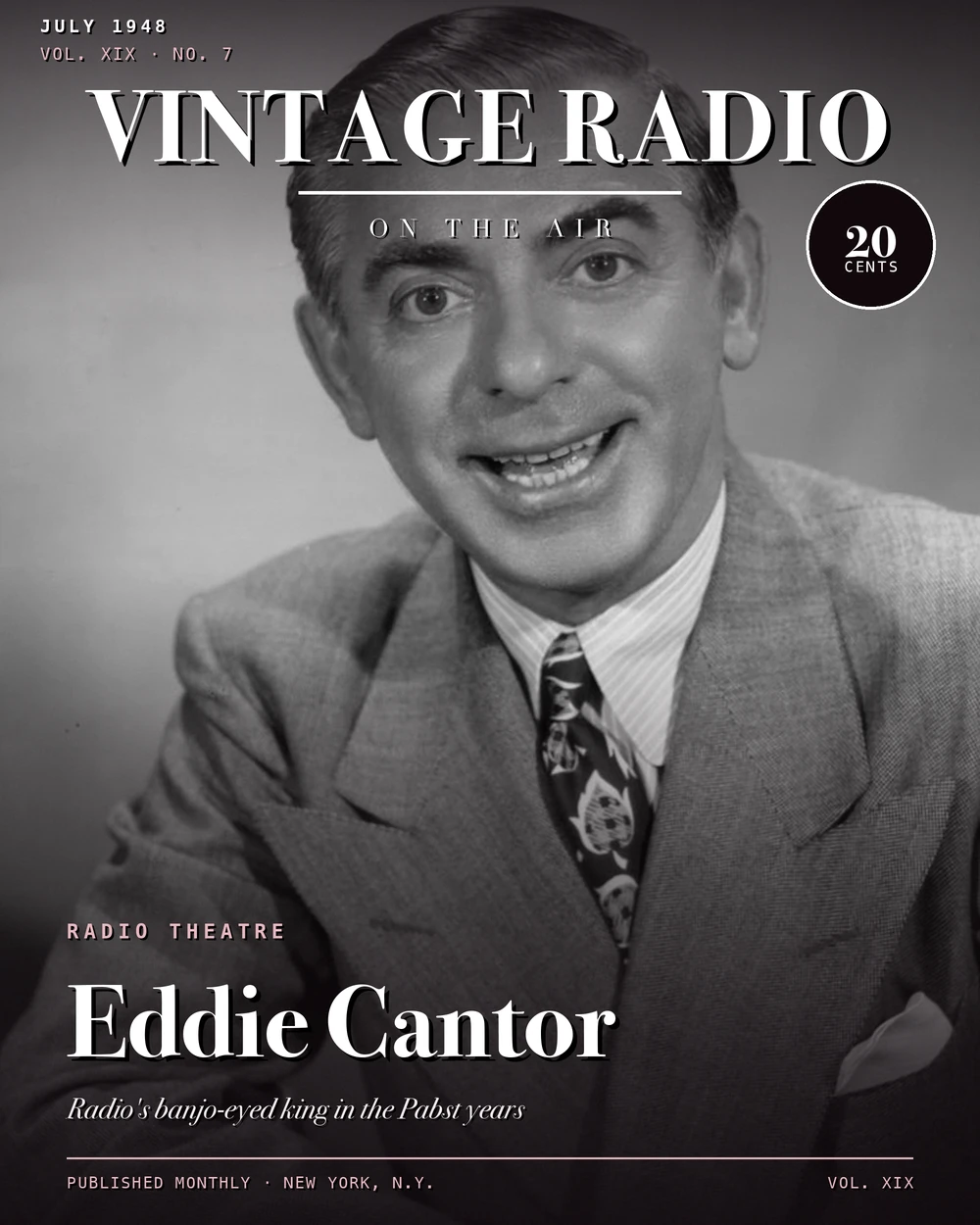
Eddie Cantor - Pabst Blue Ribbon Show
The Man Who Got There First
Before Jack Benny found his cheapskate persona, before Bob Hope turned Tuesday nights into a national institution, and before Bing Crosby figured out what to do with a microphone, Eddie Cantor was already at the top of radio. He was the first major star of vaudeville and burlesque to reach that height, ahead of Al Jolson, Ed Wynn, Fred Allen, and Benny by nearly a full year, and ahead of Hope by seven years. The only radio name who beat him to it was Rudy Vallee. Cantor made his first radio appearance on February 3, 1922, broadcasting from Newark's WDY and Pittsburgh's KDKA — both Westinghouse stations — with listeners as far away as Bridgeport, Connecticut, reporting that they could hear him sing. When he finally stepped into the national spotlight on NBC in September 1931, it wasn't a slow build. He arrived already knowing what he was doing.
Cantor had come out of poverty on New York's Lower East Side, born January 31, 1892, to Russian immigrant parents who were both dead before he turned two. His mother died shortly after his birth; his father died of pneumonia a year later. His grandmother Esther, sixty years old at the time, raised him. When he enrolled in public school at six, the registrar misread the family name Kantrowitz as "Kanter," which he eventually reshaped into Cantor. He started calling himself "Eddie" because his girlfriend Ida Tobias — who would become his wife on June 6, 1914 — liked the way it sounded. He worked as a singing waiter at Coney Island, where he met and befriended Jimmy Durante, then a piano player in the same milieu. By his early twenties, he was in the Ziegfeld Follies. By 1923, he was starring in Ziegfeld's Kid Boots, and by 1928, in the record-breaking Whoopie. His bulging eyes, promoted as a show-business trademark and dubbed "Banjo Eyes," were already famous before anyone described them on radio.
How He Changed What Radio Was
Cantor's first network engagement came almost by accident. Chase and Sanborn's advertising team at the J. Walter Thompson agency needed a replacement for French showman Maurice Chevalier, who was returning to Paris. Chevalier had been pulling a record-breaking salary of $5,000 a week from Standard Brands. Cantor came in for a four-week tryout, then was signed for a full year. What happened next was something no one in the industry had planned for.
Before Cantor, studio audiences were warned in no uncertain terms to make no noise during broadcasts. Ushers would materialize at the sound of a muffled cough. Cantor and announcer Jimmy Wallington walked into the audience, pulled hats off the wives' heads, and chased each other around the stage. The audience laughed — loudly, on-air. John Reber of J. Walter Thompson called afterward to tell Cantor he had "just invented audience participation." Whether that framing gives him too much credit or too little, the practice spread from that moment. Radio comedy was never again quite as stiff.
The ratings that followed were hard to believe at the time, and they remain startling. In his second year on the Chase and Sanborn Hour, Cantor's Crossley (CAB) rating peaked at 58.6 — the highest the service ever recorded. At his peak, his number stood as many as 15 points above the second-place show in the country. The figures were so implausible that they contributed directly to widespread industry skepticism about Crossley's methodology, ultimately helping collapse the service as a viable audience measurement tool. During the same stretch, Cantor was widely regarded as the second most recognizable person in America — second only to President Roosevelt. Radio Stars magazine, trying to pin down what drove those numbers in 1933, landed on "a keynote of impudence" — "a flip defiance of powers or persons more powerful than himself." That description holds up pretty well as a summary of the act.
One signature piece of the Chase and Sanborn show was the "Night Court of the Air," a recurring skit in which Cantor presided as judge over mock trials. The format mixed madcap comedy cases with surprisingly serious material — juvenile delinquency, drunk driving, suicide — slid in between the laughs. It was an early version of something variety radio would do for the rest of the decade: use the framework of a comedy bit to talk briefly about the real world.
Cantor also announced his candidacy for president as a radio stunt in 1932. The weekly chant "We want Cantor!" — which had reportedly originated in vaudeville, when audiences chanted to chase opening acts off the bill before Cantor could perform — translated directly into actual write-in votes. His scriptwriter during these years was David Freedman, dubbed "the Captain of Comedy"; Freedman's team included Samuel "Doc" Kurtzman, who also wrote for Al Jolson and Jack Benny. Carroll Carroll, Bob Colwell, and Phil Rapp also contributed scripts during the Chase and Sanborn period. Jimmy Wallington handled announcing duties, and violinist Dave Rubinoff was a regular presence — though Rubinoff's Russian accent was so thick he couldn't speak on-air. In the early days, Cantor voiced both sides of their exchanges himself, asking a question in his own voice and answering in a Russian accent. He later wrote of Rubinoff that he was "a good violinist rather than a great violinist" but "a showman who gave the impression of being all the great violinists put together."
One broadcast in November 1934 had consequences nobody anticipated. J. Fred Coots, a writer on the show, had been pushing Cantor to perform a new song he and Haven Gillespie had written. Other established artists had turned it down as "silly" and "childish." Cantor, reportedly persuaded by his wife Ida, performed it anyway. The song was "Santa Claus Is Comin' to Town." Sheet music orders of 100,000 copies came in the next day; 400,000 copies were sold by Christmas.
The Cast He Built Around Himself
Cantor had a genuine instinct for finding talent — and a tendency to take credit for it, which wasn't always unfair. Gracie Allen made her first radio appearance on his show; Burns and Allen were sometimes half-jokingly called a Cantor discovery. In 1934, he heard Harry Einstein doing a Greek dialect comedy bit on a local Boston station, WNAC, where Einstein — then the advertising director of Boston's Kane Furniture Company — performed a character named Nick Parkyakakas on a program sponsored by a local bandleader. The name was a pun on "park your carcass." Cantor sent a telegram, and the following Sunday, Parkyakakas played to a national audience for the first time.
Einstein stayed with Cantor through the Pebeco and Texaco years and into the Camel Caravan period. The Parkyakarkus character, a harebrained Greek-dialect figure, was so popular that Einstein eventually appeared in eleven films between 1936 and 1945, including Strike Me Pink alongside Cantor in 1936. Einstein attempted to have his name legally changed to Parkyakarkus — a judge denied the request — but his star on the Hollywood Walk of Fame bears the character's name regardless. Einstein's sons included comedian Albert Brooks and Bob Einstein, who performed as Super Dave Osborne. Harry Einstein died on November 23, 1958, of a massive heart attack suffered onstage at a Friars Club roast honoring Lucille Ball and Desi Arnaz, where the Los Angeles Times described him as delivering "the most hilarious speech of his career" before collapsing. Five physicians in attendance worked on him for two hours.
Bert Gordon joined in 1935, hired to play "the Mad Russian" — a harebrained character with a thick Slavic accent whose catchphrase was "How do you doooo." Gordon, born Barney Gorodetsky, filled a role on the show roughly parallel to what Jerry Colonna would later provide for Bob Hope: a lunatic whose presence gradually turned the star into a straight man. That same year, Cantor found child singer Bobby Breen for his Christmas show. Breen's rendition of "Santa Bring My Mommie Back to Me" moved the studio audience to tears. Breen remained for three seasons before Cantor dropped him because Breen's brother Mickey, acting as agent, made rigid demands. A casting director at Universal had also introduced Cantor to thirteen-year-old Deanna Durbin; Cantor featured her in romantic duets with Breen before Durbin returned to Universal by 1938 to build a film career of her own.
Bert Parks turned up as Cantor's announcer-singer-straight man during the Camel Caravan years, paired with singer Kay St. Germain. Cantor ran a recurring gag about trying to marry Parks to one of his five daughters — Marjorie, Natalie, Edna, Marilyn, and Janet — a bit that made Cantor's wife Ida and the girls better known to the public than many comics who had their own programs. Gerald Nachman, writing in Raised on Radio (Pantheon Books, 1998), noted that the running gag "did not always sit well with the girls," a point Natalie later confirmed.
During the Time to Smile years on NBC (1940–46), Dinah Shore — born Frances Rose Shore on February 29, 1916 — joined as a regular in 1940 after failing auditions with several big bands. She stayed through 1941, appeared in Cantor's 1943 film Thank Your Lucky Stars, and went on from there. After Shore departed, Cantor featured Thelma Carpenter, described as one of the first Black singers given a regular spot on a major variety show. In 1942, Shirley Dinsdale, a sixteen-year-old ventriloquist, joined the show with her dummy Judy Splinters. Edgar Bergen, who knew something about ventriloquism, called Dinsdale "the best natural ventriloquist I ever saw." What set Judy Splinters apart from most ventriloquist dummies was that she could actually sing — not just in falsetto, but as a rich soprano.
Why He Left and How He Came Back
Cantor's departure from Chase and Sanborn in late 1934 was clean — a film job on the West Coast for Samuel Goldwyn. He vacationed in Europe afterward, met Mussolini, and made a point of refusing to visit Germany. His explanation: "Why should I make people laugh who make my people cry?" When he returned to radio in the fall of 1935 under Pebeco Toothpaste on CBS, the Crossley system had been replaced by Hooper ratings, and his numbers started in the teens. He had not lost his audience so much as the measuring system had changed; by autumn 1936, his Hooper rating had climbed back to nearly 30 points.
The break that followed was sharper and more painful. At the 1939 New York World's Fair, Cantor publicly attacked Father Charles Coughlin and George Sylvester Viereck by name. Viereck was a German-American poet and a frequent contributor to Coughlin's Social Justice magazine, and an admitted admirer of Hitler and Mussolini. Cantor's remarks made national headlines. His sponsor, Camel Cigarettes, dropped him immediately, and no other sponsor would touch him. He was off radio for a year.
Jack Benny intervened. He pressured an executive at Young and Rubicam on Cantor's behalf, and Bristol Myers was persuaded to take on the new show. Time to Smile — the title referencing Bristol Myers' two products, Ipana toothpaste for "the smile of beauty" and Sal Hepatica for "the smile of health" — ran from October 1940 to June 1946 on NBC, with Harry Von Zell as announcer and Vick Knight directing. The Pabst Blue Ribbon sponsorship that gives the show one of its canonical names ran from September 1946 to June 1949, three full series of 39 shows each. The closing theme during those years was "I Love to Spend Each Thursday with You." The Pabst relationship eventually ended not over ratings but over television: Pabst wanted Cantor to add a weekly TV broadcast to his radio obligations. He refused. Billboard reported that Cantor and Pabst "parted friends" after several months of negotiation.
The March of Dimes, the Guild, and the Wider Record
In January 1938, Cantor coined the phrase "March of Dimes" on his radio program, asking listeners to mail a dime to President Roosevelt at the White House in support of the new National Foundation for Infantile Paralysis. The name was a play on the contemporary newsreel series The March of Time. The White House mail room received 2,680,000 dimes. The March of Dimes organization's own account credits Cantor with suggesting, at a November 1937 meeting at MGM studios, that national radio programs devote thirty seconds each to a polio relief appeal.
Cantor had also served as the second president of the Screen Actors Guild from 1933 to 1935, succeeding Ralph Morgan at a moment when the guild needed bigger names in its seats. He insisted that SAG help all actors, not just established stars, and the guild reportedly grew from about eighty members to more than four thousand within three weeks. He was elected the first national president of the American Federation of Radio Artists when it received its AFL charter in August 1937. He established a college scholarship fund for young essayists and orators during the Texaco years, continued it for a decade, and put about a dozen students through school — despite the fund's early embarrassment when its first winner was found to have plagiarized his submission.
The Last Years
In September 1950, Cantor moved to television as one of several rotating hosts on NBC's Colgate Comedy Hour. In September 1952, just after completing a Colgate taping, he suffered a heart attack. He returned to the show in 1953. One Colgate Comedy Hour appearance that spring featured The Will Mastin Trio with Sammy Davis Jr.; when Cantor embraced Davis on-air and wiped his brow with a handkerchief, it sparked a racist backlash. Cantor responded by booking Davis for two additional appearances. Davis later credited Cantor as a positive influence on his conversion to Judaism, wore a mezuzah Cantor gave him, and remained his friend until Cantor's death.
Warner Bros. produced The Eddie Cantor Story in 1953, with Keefe Brasselle in the title role. The New Yorker's review described Brasselle's attempts to replicate Cantor's eye-popping as "disconcerting," noting that his efforts "frequently conveys the impression he is being strangled." Cantor himself recorded twenty songs for the soundtrack and appeared briefly in a prologue and epilogue, delivering what became the film's punch line: "I never looked better in my life."
His disc jockey-format network show ran on NBC from October 1951 to July 1954, with Philip Morris and then the Coleman Company as sponsors, Cantor reminiscing about his career between records. Radio kept finding him afterward in smaller formats: in 1955–56, Ziv Radio Productions syndicated a daily half-hour Eddie Cantor Show, 250 episodes broadcast Monday through Friday, with Patti Lewis, Dorothy Carless, Roy Edwards, Ronnie Harris, and Jimmy Wallington — Wallington back at the microphone alongside Cantor more than twenty years after the Chase and Sanborn days. His final radio work was a syndicated daily series called Ask Eddie Cantor, 260 five-minute segments produced by Lika Production Corporation in 1961–62.
Cantor's footprint extended past radio and film into animation. He turned up as a caricature in early Warner Bros. cartoons — I Like Mountain Music and Shuffle Off to Buffalo, both released in 1933 — and he wrote the lyrics to "Merrily We Roll Along," which became the enduring theme of Merrie Melodies. More recently, Stephen DeRosa played him as a recurring character on HBO's Boardwalk Empire.
He received the Jean Hersholt Humanitarian Award — an honorary Oscar — in 1956, and an honorary doctorate from Temple University in 1951. A Presidential Commendation from Lyndon B. Johnson arrived in 1964 for his humanitarian work, just months before he died on October 10 of that year. His wife Ida had died in 1962; their daughter Marjorie's death from cancer in 1959 had already taken a severe toll on both of them. His personal papers — seventy-five boxes of memorabilia, photographs, scripts, and awards — are held by UCLA's Department of Special Collections. The Museum of Broadcast Communications' radio-encyclopedia entry concludes that "although Cantor's humor has not aged well, he deserves to be remembered as one of the most popular and influential performers during radio's golden age." That's a fair verdict, and it understates how much of the architecture he helped build.